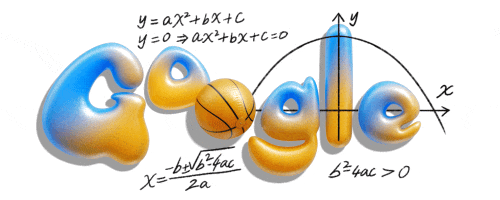
A quadratic equation is a second-degree polynomial equation in one variable, usually written in the standard form: ax2+bx+c=0ax^2 + bx + c = 0ax2+bx+c=0
where:
- a,b,ca, b, ca,b,c are real numbers,
- a≠0a \neq 0a=0.
General Solution (Quadratic Formula)
The roots (solutions) of a quadratic equation are found using the quadratic formula: x=−b±b2−4ac2ax = \frac{-b \pm \sqrt{b^2 – 4ac}}{2a}x=2a−b±b2−4ac
Here:
- The term b2−4acb^2 – 4acb2−4ac is called the discriminant (Δ\DeltaΔ):
- If Δ>0\Delta > 0Δ>0: Two distinct real roots
- If Δ=0\Delta = 0Δ=0: One real repeated root
- If Δ<0\Delta < 0Δ<0: Two complex conjugate roots
Examples
- x2−5x+6=0x^2 – 5x + 6 = 0x2−5x+6=0
- a=1,b=−5,c=6a=1, b=-5, c=6a=1,b=−5,c=6
- Discriminant: (−5)2−4(1)(6)=25−24=1(-5)^2 – 4(1)(6) = 25 – 24 = 1(−5)2−4(1)(6)=25−24=1
- Roots: x=−(−5)±12(1)=5±12x = \frac{-(-5) \pm \sqrt{1}}{2(1)} = \frac{5 \pm 1}{2}x=2(1)−(−5)±1=25±1 So, x=2x=2x=2 or x=3x=3x=3.
- 2×2+4x+2=02x^2 + 4x + 2 = 02×2+4x+2=0
- a=2,b=4,c=2a=2, b=4, c=2a=2,b=4,c=2
- Discriminant: 16−16=016 – 16 = 016−16=0
- One root: x=−44=−1x = \frac{-4}{4} = -1x=4−4=−1